
Swift Testing vs. XCTest: Why Passing Tests Don’t Always Mean Happy Users

A few days ago, I was watching Apple's WWDC26 session on "Migrate your tests to Swift Testing".
As someone who spends a lot of time around mobile testing conversations, my first immediate thought was simple: Is this Apple's next big leap in test automation?
The excitement around Swift Testing is really hard to miss right now. Apple is clearly investing heavily in it as the future direction for testing in Swift, and developers everywhere are talking about the cleaner syntax, better organization, and the ability to gradually migrate away from XCTest. At first glance, it almost feels like testing is finally becoming easier.
But the deeper I went down the rabbit hole, the more I realized something incredibly important. Passing tests do not always mean happy users. And that single realization completely changed how I think about mobile QA.
Swift Testing vs. XCTest at a Glance
For years, XCTest has been the default framework for iOS applications to verify basic code behavior, like checking if a discount calculation returns the right value. Swift Testing is Apple's modern answer designed specifically for Swift. Here is how they stack up right now:
| Feature | XCTest | Swift Testing |
|---|---|---|
| Maturity | Mature and battle-tested | Modern and evolving baseline |
| Syntax | More verbose and legacy-driven | Cleaner, expressive, and macro-based |
| Adoption | Widely used across enterprise teams | Growing rapidly with Swift 6 |
| UI Testing | Strong native support via XCUITest | Still relies on XCUITest under the hood |
| Coexistence | The old reliable standard | Works smoothly alongside existing suites |
What is particularly interesting is that Apple is not asking teams to throw away their existing test suites overnight. The focus is entirely on gradual, incremental migration. Most teams live in hybrid environments anyway, and testing is no different.
The more I learned, the more I realized that this is not a simple story of replacement. It is a story of evolution.
My First Realization: The Illusion of the Green Build
This is where things became interesting for me. Let's imagine a standard e-commerce app. The engineering team has written extensive test suites, the login API works perfectly, the payment gateway behaves, and every single unit test passes. The CI/CD pipeline is completely green. Everything looks absolutely flawless.
Until a real user opens the app.
Imagine a promotional banner accidentally rendering right on top of the "Checkout" button. Suddenly, your unit tests pass, your Swift Testing suites are green, and your CI pipeline is happy. But your users literally cannot complete a purchase.
Nothing is technically broken in the code. Yet, the user experience is completely broken. Real users do not care whether a backend unit test passed. They care whether the app actually works in their hands. This is the massive gap between code quality and experience quality.
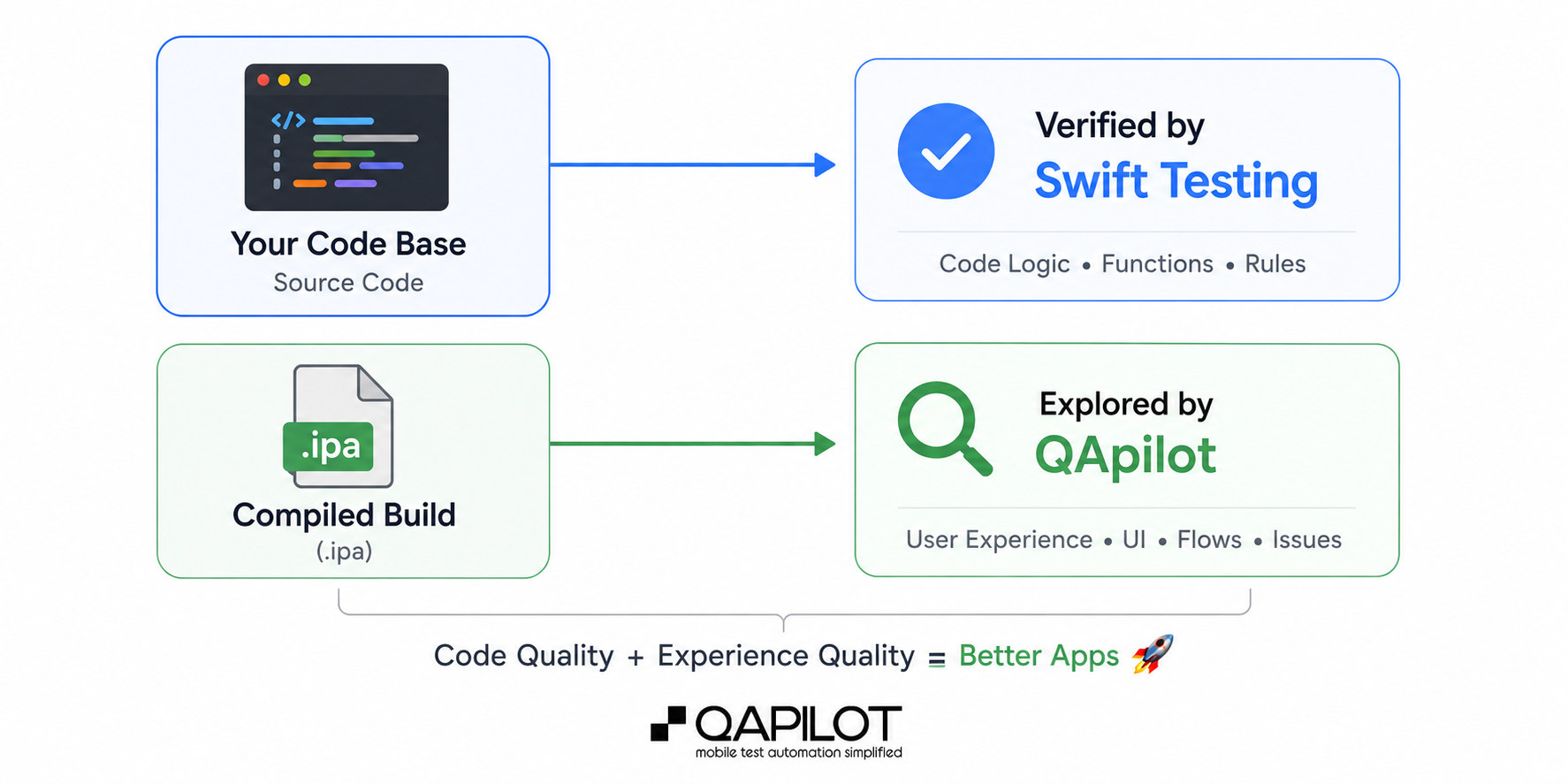
Understanding the Different Layers of Testing
As I continued exploring this topic, I realized that not all testing serves the same purpose, and we really need to think of testing in distinct layers.
Unit Testing: This is where you verify small pieces of code in isolation, like checking password validation or tax logic. Swift Testing absolutely shines here.
Integration Testing: This ensures different systems talk to each other correctly, like verifying API communication or database saves.
End-to-End Testing: This is where things become real. End-to-end tests behave exactly like actual users by signing in, browsing products, and walking through full flows.
This is often where hidden issues surface because users do not interact with isolated functions. They interact with full screens, buttons, gestures, and fluid journeys. Swift Testing primarily strengthens code-level confidence, while end-to-end testing validates the actual user experience. Both matter tremendously.
The Real-World Challenge: Test Maintenance and Human Chaos
Writing tests is only half the battle, and anyone working in QA knows that keeping them relevant is often the hardest part. Mobile apps evolve fast, layouts change, and features get redesigned. A small UI change can break dozens of scripted automation tests, leaving teams spending significant time fixing old scripts instead of improving overall quality.
To make matters more challenging, real users rarely follow perfect, pre-defined scripts. They tap unexpected buttons, navigate in unusual sequences, and explore features in ways we never planned. Traditional scripted automation validates expected paths, but human behavior is delightfully unpredictable.
This is exactly why the conversation is shifting toward autonomous testing. Instead of manually scripting every single scenario, what if the system could explore the application more like a real user? This feels less like rigid automation and much more like true exploration.
Testing the App Users Actually Experience
At this point, one core idea kept coming back to me: modern mobile testing is not just about writing more lines of test code. It is about understanding the application the way users actually experience it.
This is also why platforms like QApilot are taking a completely fresh approach to mobile QA. Instead of starting inside the codebase, QApilot starts with the final application package itself.
Imagine uploading your built IPA or APK file and letting an autonomous system crawl the application, discover screens, build a dynamic knowledge graph of the UI, and generate test cases automatically.
This approach does not replace great frameworks like Swift Testing or XCTest. In fact, they complement each other beautifully. Code-level testing answers the question, "Is the code behaving correctly?" Meanwhile, autonomous end-to-end testing answers the question, "Is the experience working smoothly?"
The Future Isn't Either-Or
When I first started looking into Apple's updates, I thought the big debate was just about replacing XCTest with Swift Testing. But the real challenge is building confidence across every single layer of quality.
Swift Testing gives you incredible code-level confidence. End-to-end testing gives you user confidence. And autonomous testing helps you keep pace with rapidly evolving applications without drowning in test maintenance.
None of these approaches need to replace the others. Together, they create much better software because, at the end of the day, users do not experience code. Users experience products. Passing tests are incredibly important, but happy users are what truly matter.